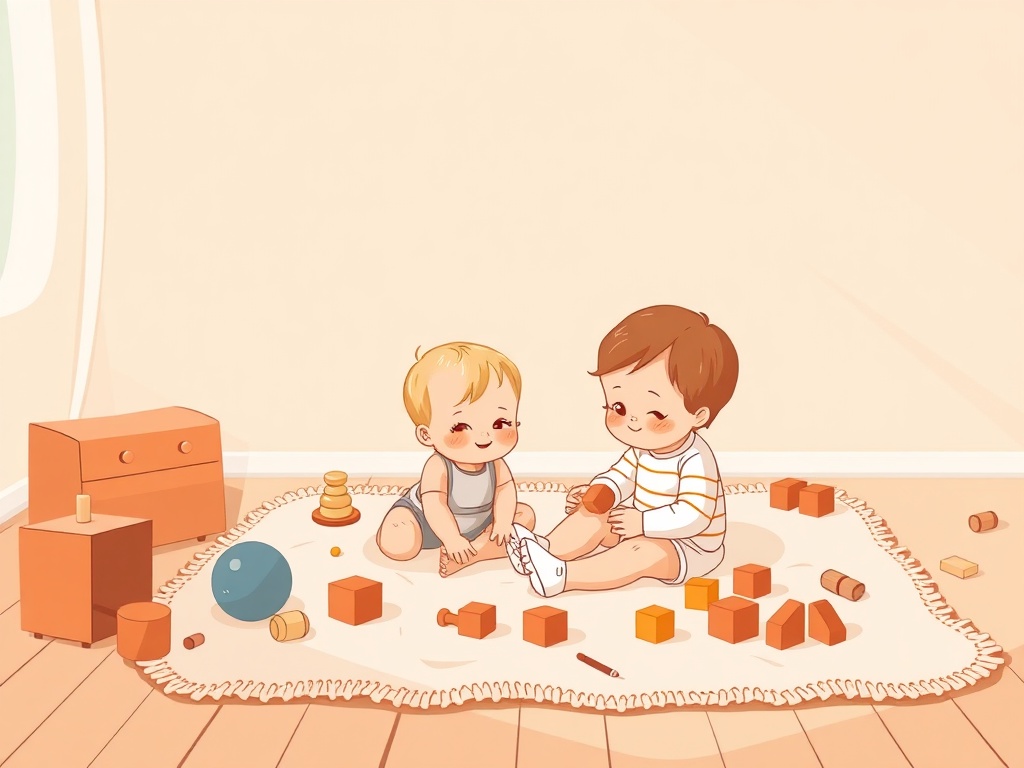
The toy industry sells the idea that more technology equals more development. It does not. The toys that best support the infant brain are, consistently, the simplest ones.
This guide is based on developmental science — not advertising. Here is what to buy, what to avoid, and why the “most expensive toy in the catalogue” is rarely the best investment.
The central principle: the right toy at the right stage
A “good” toy is one that:
- Matches the current developmental level (not too easy, not too hard)
- Requires active participation (not just pressing a button)
- Can be used in multiple ways (open-ended)
- Is safe for the age group
Ages 0–3 months
Baby has limited vision (prefers high contrast at 20–30cm), active hearing, and uses the mouth as primary exploratory organ.
What works:
- Black and white mobile — high contrast stimulates the developing visual system
- Light rattle — to hold and shake (emerging fine motor)
- Unbreakable mirror — babies are fascinated by faces, including their own
- Your face — literally the best “toy” at this stage
Avoid: Electronic toys with loud sounds, too many visual stimuli at once
Ages 3–6 months
Baby intentionally grasps objects, puts everything in their mouth, starts rolling.
What works:
- Silicone teething ring (BPA-free) — oral exploration + motor development
- Textured balls — to explore with hands and mouth
- Floor activity gym — for tummy time, with hanging objects to bat at
- Soft books / bath books — high contrast, textures, safe for the mouth
- Different-shaped rattles — each one sounds and feels different
Ages 6–12 months
Baby sits, crawls, pulls to standing. Object permanence is emerging. Everything goes in the mouth.
What works:
- Simple shape sorter (3–4 shapes, not 12)
- Board books with flaps — lifting flaps is object permanence + fine motor
- Balls of different sizes — to roll, chase, throw
- Stacking cups — nesting and stacking; concept of size and order
- Push toy — when they start taking steps with support
Best investment: A set of coloured stacking cups. Used from 6 months to age 3 in completely different ways. Costs £3–8 and has enormous return on investment.
Ages 12–18 months
The toddler is upright, starting to walk, with voracious curiosity and proportional frustration.
What works:
- Walking push toy — stable, does not move too fast
- Inset puzzles (3–5 pieces with pegs) — fine motor development
- Simple cause-and-effect toys — cars that roll, drums that sound
- Touch-and-feel books — language + sensory
- Play dough / non-toxic modelling clay — manipulation, fine motor
- Simple kitchen play set — the start of symbolic play
Avoid: Toys with too many small pieces; toys that do everything automatically
Ages 18 months – 2 years
Language is exploding. Symbolic play is emerging. The toddler wants to do everything independently.
What works:
- Wooden blocks (10–20 pieces) — free building, physics, motor skills
- 6–12 piece puzzles — with more complex images now
- Simple puppet set — great for language
- Shopping cart or baby stroller — symbolic play in motion
- Washable paints + large paper — creative expression, sensory
- Simple story books — emerging narrative
Ages 2–3 years
Imagination in full swing. Wants to pretend. Starts playing near (but not yet with) other children.
What works:
- LEGO Duplo (large pieces) — construction, creativity, storytelling
- Doctor kit / tool set / full kitchen — rich symbolic play
- 12–24 piece puzzles — growing spatial reasoning
- Playdough / clay — free modelling, fine motor
- Colouring books + wax crayons — emerging graphic expression
- Simple memory games — attention, visual memory
What never works
“Educational” tablets for babies: Below 2 years, no demonstrated benefits for development, and real risks for sleep and language.
Toys that do everything: If the toy plays music, lights up, counts, and dances on its own, nothing is left for the child to do. Development happens through action, not passivity.
Buying “ahead”: A 100-piece puzzle for an 18-month-old does not make them smarter — it creates frustration.
Too many toys at once: Research shows children with fewer toys available play more creatively and for longer.
The best “toy” of all? Consistently, research shows that interaction with attentive, caring adults is more powerful for development than any toy.
Our Play by Age Guide gives you exactly that: not just the what, but the how — what to say, how to respond, how to turn 20 minutes of playtime into real development.
See also: Activities for 1–2 Year Olds | Baby Speech Development